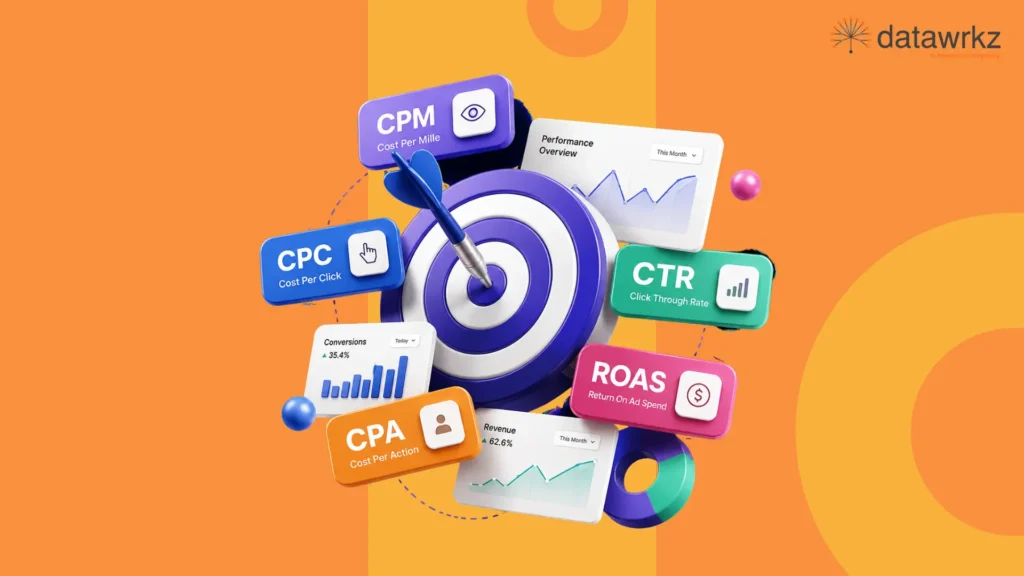
The UK alone spent £40.5 billion on digital advertising in 2025. Yet some of the most important decisions in advertising are still based on misunderstood metrics.
A campaign with a high CTR can still fail.
A campaign with a low CPA can still attract poor-quality customers.
A campaign with a high ROAS can still lose money.
The numbers themselves aren’t the problem. The interpretation is. As advertising becomes more measurable, success increasingly depends on understanding what each metric actually tells you and where its limitations begin. That’s why every advertiser, agency, and media buyer should understand the fundamentals behind CPM, CPC, CTR, CPA, ROAS, viewability, and attribution.
TL;DR
- CPM, CPC, CTR, CPA, and ROAS are the five metrics that appear in virtually every campaign brief; each measures a different stage of the funnel.
- Viewability is not the same as an impression: an ad must have at least 50% of its pixels on-screen for 1 second (2 seconds for video) to count as viewable under MRC/IAB standards.
- ROAS is a revenue-over-spend ratio, not a profit metric — it does not account for margin, COGS, or operational costs.
- According to IAB UK, search advertising accounted for 44% of UK digital advertising spend in 2025, making performance metrics such as CPC, CPA, and ROAS increasingly important for advertisers.
- Each metric answers a specific question: CPM answers “how much to reach?”, CTR answers “how relevant is the creative?”, CPA answers “what does a conversion cost?”, ROAS answers “how much revenue was generated from advertising spend?”
What are digital advertising metrics?
Digital advertising metrics are measurable indicators used to evaluate the performance of online advertising campaigns. They help advertisers understand reach, engagement, conversions, revenue, and return on investment across channels such as search, display, social media, video, and programmatic advertising.
Common digital advertising metrics include CPM, CPC, CTR, CPA, ROAS, viewability, frequency, and attribution metrics.
The Digital Advertising Metrics at a Glance
| CPM
Cost Per Mille The cost of serving 1,000 ad impressions. CPM has been the most widely used pricing model for awareness and reach-focused campaigns. |
CPC
Cost Per Click The amount an advertiser pays each time someone clicks on an ad. CPC is commonly used across search ads & performance-driven display campaigns. |
CTR
Click-Through Rate The percentage of impressions that generate a click. CTR is often used as an indicator of creative effectiveness and audience relevance. |
| CPA
Cost Per Acquisition The total advertising spend required to generate a conversion. CPA is one of the most important efficiency metrics for performance marketers. |
ROAS
Return on Ad Spend The amount of revenue generated for every pound spent on advertising. ROAS is a key metric for evaluating commercial performance. |
VCR
Video Completion Rate The percentage of video ads that viewers watch all the way through. VCR is particularly important for video advertising and brand storytelling campaigns. |
What is CPM and when should you use it?
CPM, or Cost Per Mille, is the cost an advertiser pays for every 1,000 impressions served. It is the standard pricing model used in display and programmatic advertising. The formula is straightforward:
CPM = (Total Spend ÷ Total Impressions) × 1,000
CPM is most commonly used for brand awareness and reach campaigns where the objective is visibility rather than immediate action.
For example, a £5 CPM means an advertiser spends £5,000 to deliver one million impressions.
However, CPM only measures the cost of delivering impressions. It does not indicate whether users clicked on the ad, converted, or even had an opportunity to see it. That’s why many advertisers also monitor viewability and viewable CPM (vCPM) when evaluating campaign performance.
What is the difference between CPC and CTR?
CPC and CTR are often discussed together because both relate to user engagement, but they measure very different things.
CTR, or Click-Through Rate, measures the percentage of impressions that resulted in a click. It helps answer a simple question: after seeing the ad, how many people decided to engage with it?
CPC, or Cost Per Click, measures how much an advertiser paid for each of those clicks.
CTR = (Clicks ÷ Impressions) × 100
CPC = Total Spend ÷ Total Clicks
CTR is often used as a measure of creative relevance and audience targeting. CPC measures traffic efficiency.
A high CTR combined with a low CPC generally indicates that an ad is attracting engagement efficiently. A low CTR and high CPC may suggest issues with creative performance, audience targeting, or auction competition.
Neither metric measures business outcomes directly. They indicate engagement, not conversions or revenue.
What does CPA actually measure, and how is it different from CPL?
CPA, or Cost Per Acquisition, measures the average amount spent to generate a conversion.
The formula is simple:
CPA = Total Spend ÷ Number of Conversions
A conversion could be a purchase, lead submission, software trial, download, or any other defined action.
CPA is one of the most important performance marketing metrics because it directly connects advertising spend to outcomes.
It’s important to distinguish CPA from CPL (Cost Per Lead). CPL is a specific type of CPA where the conversion is a lead rather than a completed sale.
For many UK B2B campaigns, CPL is often more relevant because revenue is generated later through offline sales activity.
A lower CPA generally indicates greater efficiency, but it should always be evaluated alongside conversion quality and revenue impact.
What is ROAS and why isn’t it the same as ROI?
ROAS, or Return on Ad Spend, measures how much revenue is generated for every pound spent on advertising. In simple terms, it answers the question: “For every £1 invested in ads, how much revenue came back?”
The formula is:
ROAS = Revenue from Ads ÷ Total Ad Spend
If a campaign generates £40,000 in revenue from £10,000 in ad spend, the ROAS is 4. In other words, every £1 spent on advertising generated £4 in revenue.
ROAS is one of the most widely used performance marketing metrics because it provides a direct connection between advertising spend and revenue.
However, ROAS and ROI are not the same thing.
ROAS measures revenue only. It does not account for product costs, fulfilment expenses, operational costs, agency fees, or profit margins.
ROI includes all costs associated with generating that revenue.
As a result, a campaign can have a strong ROAS while still being unprofitable.
For ecommerce advertisers and agencies, establishing a target ROAS (tROAS) before launching a campaign helps determine whether advertising activity is commercially sustainable.
What is viewability and how is it measured?
Not every impression has the same value. Just because an ad was served doesn’t necessarily mean a user had the opportunity to see it. That’s where viewability comes in. Viewability measures whether an ad had a genuine chance of being seen by a real person.
According to MRC and IAB standards:
- A display ad is considered viewable when at least 50% of its pixels are visible on screen for a minimum of one continuous second.
- A video ad is considered viewable when at least 50% of its pixels are visible for a minimum of two continuous seconds.
- For large-format display ads exceeding 242,000 pixels, only 30% of pixels must be visible for one second.
A served impression and a viewable impression are not the same thing. An ad can be served by an ad server without ever being meaningfully seen by a user. This distinction is why advertisers increasingly monitor viewability rates alongside impression volumes.
Viewability is typically measured using accredited third-party verification providers. It also forms the basis of vCPM, where advertisers pay for viewable impressions rather than all served impressions.
How do these metrics map to the campaign funnel?
Each metric answers a different question at a different stage of engagement.
CPM / vCPM
How much does it cost to reach the audience?
Viewability
Did the audience have an opportunity to see the ad?
CTR / VCR
Did the audience engage with the creative?
CPC
How efficiently did engagement generate website visits?
CPA / ROAS
Did those visits generate business results?
Looking at metrics in isolation can create misleading conclusions.
For example, a campaign may have a strong CTR but a weak ROAS if clicks are not converting into revenue. Similarly, a low CPM may not be valuable if viewability rates are poor. The most effective media buyers evaluate metrics together rather than focusing on a single number.
What is frequency, and why does it matter to media buyers?
Frequency measures the average number of times a unique user sees an ad within a specific period.
Frequency = Total Impressions ÷ Unique Reach
If a campaign delivers 100,000 impressions to 20,000 unique users, the average frequency is five. In other words, each person saw the ad approximately five times.
Frequency helps advertisers balance visibility and efficiency. If frequency is too low, audiences may not remember the message. If frequency is too high, ad fatigue can occur, reducing engagement and potentially harming brand perception.
Most DSPs and advertising platforms offer frequency caps to help control exposure levels and improve campaign performance.
What is invalid traffic (IVT), and how does it affect reported metrics?
Not every click, impression, or conversion comes from a real person.
Invalid Traffic, commonly referred to as IVT, includes activity generated by bots, crawlers, automated systems, and fraudulent sources rather than genuine users.
IVT can distort campaign performance and create misleading reporting outcomes.
The MRC categorises invalid traffic into two primary groups:
General Invalid Traffic (GIVT)
Known bots, crawlers, and automated systems that can be identified through standard filtering methods.
Sophisticated Invalid Traffic (SIVT)
More advanced forms of ad fraud, including adware, disguised traffic sources, manipulated inventory, and other techniques designed to imitate genuine user behaviour.
Because invalid traffic can affect campaign measurement, advertisers should work with accredited verification providers that can identify and filter fraudulent activity before reporting and optimisation decisions are made. The cleaner the data, the more reliable the optimisation process becomes.
What is the difference between a post-click and post-view conversion?
A post-click conversion occurs when a user clicks an ad and later completes a conversion within the attribution window.
A post-view conversion occurs when a user sees an ad, does not click it, but later converts within the attribution window.
Post-view attribution is commonly used in display and video advertising, where campaigns often influence consideration rather than immediate action.
Typical attribution windows include 1 day, 7 days, and 30 days.
The length of the attribution window directly affects reported CPA and ROAS figures. Longer windows generally increase attributed conversions but may weaken the direct relationship between ad exposure and conversion.
Which digital advertising metrics matter most?
The most important digital advertising metrics depend on campaign objectives:
- Brand awareness: CPM, Viewability, Reach, Frequency
- Traffic generation: CTR, CPC
- Lead generation: CPL, CPA
- Ecommerce: ROAS, CPA, Conversion Rate
- Video advertising: VCR, Viewability
Most advertisers use multiple metrics together because no single metric provides a complete picture of performance.
Frequently asked questions
What is conversion rate?
Conversion Rate measures the percentage of visitors who complete a desired action after clicking an ad. Conversion Rate = (Conversions ÷ Clicks) × 100. It helps advertisers understand how effectively website traffic turns into business outcomes.
Is a high CTR always a good sign?
Not necessarily. A high CTR often indicates relevant creative and targeting, but it does not guarantee conversions or revenue. CTR should always be evaluated alongside conversion rate, CPA, and ROAS.
What is a good ROAS benchmark for UK ecommerce?
There is no universal benchmark. The required ROAS depends on gross margin, operating costs, and profitability targets. A retailer with a 25% gross margin may need a ROAS of at least 4 simply to break even on advertising spend.
What does a viewability rate below 50% indicate?
It often suggests poor inventory quality, weak ad placement, slow page loading, or potential ad fraud. Many advertisers target viewability rates of 70% or higher for premium display inventory.
Can CPM and CPC campaigns run simultaneously?
Yes. Most advertising platforms and DSPs support both buying models within the same account. CPM is often used for awareness objectives, while CPC is commonly used for performance-focused campaigns.
What is eCPM?
eCPM (effective Cost Per Mille) converts revenue or campaign performance into a CPM equivalent. eCPM = (Total Earnings ÷ Total Impressions) × 1,000. Publishers commonly use eCPM to compare inventory performance across different monetisation models.
What is the difference between reach and impressions?
Impressions measure the total number of times an ad was served. Reach measures the number of unique individuals who saw the ad. The relationship between reach and impressions determines frequency.
Is CPM a programmatic-only metric?
No. CPM is used across programmatic advertising, direct media buying, paid social, video advertising, and digital out-of-home campaigns.
What is the difference between ROAS and CPA?
CPA measures the cost of generating a conversion. ROAS measures the revenue generated from advertising spend. CPA focuses on efficiency, while ROAS focuses on revenue performance.
Final Takeaway
No single digital advertising metric tells the full story of campaign performance.
CPM measures reach. Viewability measures the opportunity to be seen. CTR and VCR measure engagement. CPC measures traffic efficiency. CPA and ROAS measure business outcomes. The most common reporting mistakes include treating ROAS as ROI, comparing CTR across different formats without context, and evaluating CPA using attribution windows that are too broad.
For UK agencies and advertisers, understanding how these metrics work together is essential for accurate reporting, better optimisation, and stronger campaign results.