A common assumption in programmatic advertising is that once targeting, creative, and budget are locked in, the hard decisions are over.
Then two campaigns launch with nearly identical audiences, spend, and goals. One delivers exactly where it should, appearing alongside premium content in brand-safe environments. The other struggles with inconsistent inventory quality, weaker performance, and placements the advertiser would rather avoid.
What changed?
Often, the answer isn’t the audience or the creative. It’s the deal type.
Behind every programmatic impression is a transaction model that determines who can buy the inventory, how much transparency buyers get before bidding, how pricing works, and how much control advertisers have over where their ads appear. In many ways, the deal type quietly shapes the entire buying experience long before the first impression is served.
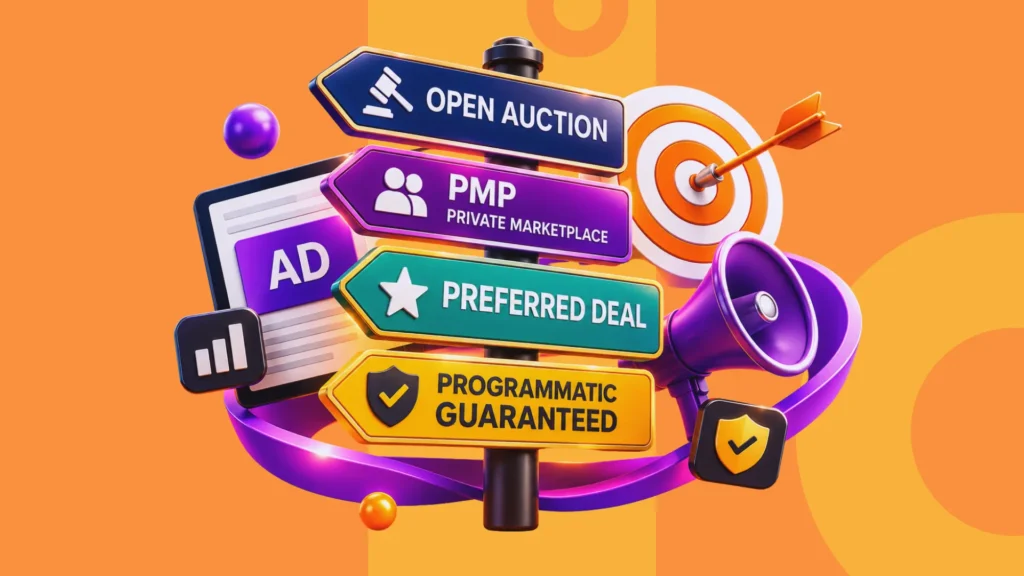
The IAB classifies these transaction models into four categories: Open Auction, Invitation-Only Auction (private marketplace), Unreserved Fixed Rate (preferred deal), and Automated Guaranteed (programmatic guaranteed). They all run on the same real-time bidding infrastructure, but they operate very differently once a campaign enters the market.
For media buyers, this isn’t just industry terminology. Choosing the wrong deal type can mean paying premium prices for inventory that doesn’t need premium treatment, or chasing scale through channels that create unnecessary brand-safety risks. It’s one of the most overlooked planning decisions in programmatic, yet it can have a direct impact on campaign outcomes.
So how do these deal types actually work? Why do some campaigns rely on Open Auction while others use PMP or Programmatic Guaranteed? And how should advertisers decide which option fits a specific objective?
Let’s break down each deal type, how it works behind the scenes, and the trade-offs between scale, control, cost, and delivery certainty.
TL;DR
- Open auction (RTB) is unreserved, open to any buyer, and offers scale at the lowest CPMs but carries the highest exposure to made-for-advertising (MFA) inventory and brand-unsafe placements.
- PMP (private marketplace) is an invitation-only auction with a Deal ID, giving buyers priority access and pricing control without a delivery guarantee.
- Preferred deals let one buyer get first look at inventory at a fixed CPM before it hits the PMP or open auction but the publisher isn’t obligated to reserve it, and the buyer isn’t obligated to buy.
- Programmatic guaranteed (PG) is the only deal type where both impression volume and price are contractually fixed, closest to a traditional direct buy, just automated.
- Inventory control increases in this order: Open Auction → PMP → Preferred Deal → Programmatic Guaranteed, and CPMs generally rise in the same order.
Open Auction vs PMP vs Preferred Deal vs Programmatic Guaranteed
| Aspect | Open Auction | PMP (Private Marketplace) | Preferred Deal | Programmatic Guaranteed |
| Access | Any eligible buyer | Invited buyers only | One buyer, by invitation | One buyer, by negotiation |
| Pricing | Real-time bid, no fixed floor guarantee | Auction above a set floor price | Fixed CPM, negotiated | Fixed CPM, negotiated |
| Impression guarantee | None | None | None | Guaranteed volume |
| Buyer obligation | Bid-by-bid, no commitment | Bid-by-bid, no commitment | No obligation to buy | Contractual commitment |
| Deal ID used | No | Yes | Yes | Yes |
| Relative CPM | Lowest | Moderate | Higher | Highest |
| Brand safety control | Lowest | Higher (curated, invite-only) | High (single buyer, known publisher) | Highest (fully negotiated) |
| Typical use case | Scale, reach, retargeting | Curated premium inventory at scale | First-look access to specific inventory | Guaranteed delivery for premium/high-stakes placements |
What is a private marketplace (PMP) in programmatic advertising?
A Private Marketplace, or PMP, is an invitation-only auction. Instead of opening inventory to every advertiser in the market, a publisher creates a private deal and invites selected buyers to participate.
These deals are typically identified using a Deal ID, which tells the DSP that the buyer has access to that specific inventory package. Even though access is restricted, a PMP is still an auction. A PMP can use auction-based bidding among invited buyers, with the deal’s pricing rules and publisher floor determining how bids compete.
Publishers often use PMPs to offer premium content categories, audience segments, or ad formats to trusted buyers. For advertisers, PMPs provide more transparency and better inventory quality than the open auction, while still allowing real-time bidding.
That’s why many marketers see PMPs as the middle ground between open exchange buying and direct publisher deals.
What is programmatic guaranteed (PG) and when should you use it?
Programmatic Guaranteed, often called PG, is the closest thing to a traditional direct media buy. In this setup, one publisher and one advertiser agree on two things before the campaign begins: The CPM and the number of impressions. There is no auction. The publisher commits to delivering a specific volume of impressions, and the advertiser commits to paying for them.
The difference is that campaign setup, delivery, reporting, and trafficking are handled programmatically rather than manually. Programmatic Guaranteed is especially useful when delivery certainty matters. For example product launches, event-based campaigns, homepage takeovers, fixed campaign flights, and premium sponsorships. In these situations, missing delivery targets is not an option.
However, PG is usually less suitable for performance campaigns that rely on constant optimization across multiple publishers because pricing and inventory are locked in advance.
What is a preferred deal and how does it differ from PMP?
A Preferred Deal sits between PMP and Programmatic Guaranteed. With a Preferred Deal, a publisher offers inventory to one specific buyer at a fixed, negotiated CPM. The buyer gets first access to that inventory before it becomes available through a PMP or the open auction.
There are three major differences between a Preferred Deal and a PMP. First, a Preferred Deal involves a single buyer, while a PMP can include multiple invited buyers. Second, the price is fixed in a Preferred Deal. In a PMP, pricing is determined through an auction.
Third, neither side is obligated. The advertiser doesn’t have to buy the inventory, and the publisher doesn’t have to reserve it indefinitely.
A Preferred Deal gives advertisers more pricing certainty than a PMP, but it doesn’t guarantee delivery like Programmatic Guaranteed does. You can think of it as a first-look agreement rather than a guaranteed reservation.
What is open auction (OA) and what are its risks for brand safety?
Open Auction, also known as RTB, Open Exchange, or Open Marketplace, is the most common form of programmatic buying. Any eligible buyer can participate. Whenever an ad impression becomes available, advertisers bid in real time, and the winning bid gets the placement.
Because there are no invitation requirements or direct relationships needed, Open Auction provides enormous scale. It also tends to deliver the lowest CPMs. That’s why it’s often used for reach, awareness, prospecting, and retargeting campaigns.
However, scale comes with tradeoffs. Since inventory quality can vary widely, advertisers face greater exposure to made-for-advertising, or MFA, websites and other lower-quality placements. Industry research has found that a significant share of open-web programmatic impressions can appear on MFA sites. As a result, advertisers typically apply safeguards such as inclusion and exclusion lists, ads.txt verification, third-party measurement tools, and supply-path optimization.
Open Auction remains a valuable buying channel, but it generally requires more active quality control than PMP or guaranteed deals.
Which deal type gives the most inventory control?
Programmatic Guaranteed provides the highest level of inventory control. Because the publisher, placement, CPM, and impression volume are all negotiated in advance, advertisers know exactly what they’re buying. Nothing depends on auction outcomes.
Control decreases moving down the stack: preferred deals give first-look priority and price certainty but no delivery guarantee; PMPs give curated access and floor-price control but the outcome still depends on winning an auction against other invited bidders; open auction gives the least control, since any eligible buyer can compete for the same impression and the publisher has minimal say over who wins.
As a rule of thumb, inventory control and CPM move together. The more certainty a buyer wants over where an ad runs and to whom, the more it typically costs relative to open auction rates.
When do agencies use PG over PMP?
Agencies typically choose Programmatic Guaranteed when delivery certainty is critical. Examples include homepage takeovers, major sponsorships, product launches, campaigns tied to specific events, and high-profile brand campaigns.
In these cases, agencies want the predictability of a direct buy while still benefiting from programmatic workflows and reporting. PMPs are more commonly used for always-on campaigns and performance-focused activity. They provide access to premium inventory and stronger brand-safety controls without requiring a fixed volume commitment.
This distinction matters because programmatic now accounts for the majority of display advertising transactions. As a result, choosing the right deal type has become an important part of campaign planning, inventory management, and brand-safety strategy.
FAQs
Is programmatic guaranteed the same as programmatic direct?
Not exactly. Programmatic Direct is a broader category that includes both Preferred Deals and Programmatic Guaranteed. Programmatic Guaranteed is the guaranteed-delivery version of Programmatic Direct.
Do PMP deals use a Deal ID?
Yes. A Deal ID is used to identify and manage the negotiated terms between buyers and publishers. Deal IDs are commonly used in PMPs, Preferred Deals, and Programmatic Guaranteed transactions.
Which deal type is cheapest?
Open Auction generally delivers the lowest CPMs because pricing is determined through unrestricted competitive bidding.
Can a campaign use more than one deal type at once?
Yes. Many advertisers combine multiple deal types within a single campaign. For example, they may use Open Auction for scale while using PMP or Programmatic Guaranteed for premium placements.
Does PMP guarantee impressions?
No. A PMP is still an auction environment. Only Programmatic Guaranteed provides a contractual commitment to deliver a specific volume of impressions.
Are Preferred Deals exclusive to one buyer?
Yes. Unlike a PMP, which can include multiple invited buyers, a Preferred Deal is negotiated between one publisher and one advertiser.
Final Takeaway
All four deal types operate within the same programmatic ecosystem, but they solve different problems. Open Auction focuses on reach and efficiency. PMP adds curation and greater control while keeping auction-based buying. Preferred Deals offer fixed pricing and first-look access for a single buyer. Programmatic Guaranteed removes auction uncertainty altogether by locking in both price and delivery.
Instead of deciding which deal type is best, the key is deciding what your campaign values most. If you need maximum scale, Open Auction may be the answer. If you need curated inventory, a PMP could be the better fit. If pricing certainty matters, consider a Preferred Deal. And if guaranteed delivery is essential, Programmatic Guaranteed is usually the strongest option.