What if the next major media company isn’t a publisher, broadcaster, or social platform, but a retailer?
A decade ago, that idea would have sounded unlikely. Retailers bought advertising to drive store visits, promote products, and compete for consumer attention. Media companies owned audiences. Retailers sold products. Today, those lines are blurring.
Every time a shopper scans a loyalty card, browses an ecommerce site, adds products to a basket, or completes a purchase through an app, retailers collect something incredibly valuable: real purchase data. Not what consumers say they like. Not what algorithms think they might buy. What they actually buy. As third-party cookies become less reliable and privacy regulations reshape digital advertising, that transaction data has become one of the most valuable targeting assets in the market. The result is retail media: one of the fastest-growing channels in digital advertising and now the third-largest digital advertising category behind search and social.
For agencies and media buyers, understanding retail media is no longer optional. It is becoming a core part of modern media planning. This guide explains what retail media is, how retail media networks work, the difference between on-site and off-site retail media, how sponsored products differ from programmatic display, and why closed-loop measurement has become one of the channel’s biggest advantages.
TL;DR
- A retail media network (RMN) is an advertising platform owned by a retailer that lets brands target shoppers using first-party purchase data.
- On-site retail media appears on retailer-owned channels like websites and apps, while off-site retail media uses retailer audiences across channels such as the open web, social, and CTV.
- Sponsored products are CPC-based ads within retailer environments, while programmatic display is an automated buying method.
- Retail media’s biggest advantage is closed-loop measurement, which links ad exposure directly to verified purchases for more accurate attribution and ROAS reporting.
What is a retail media network (RMN)?
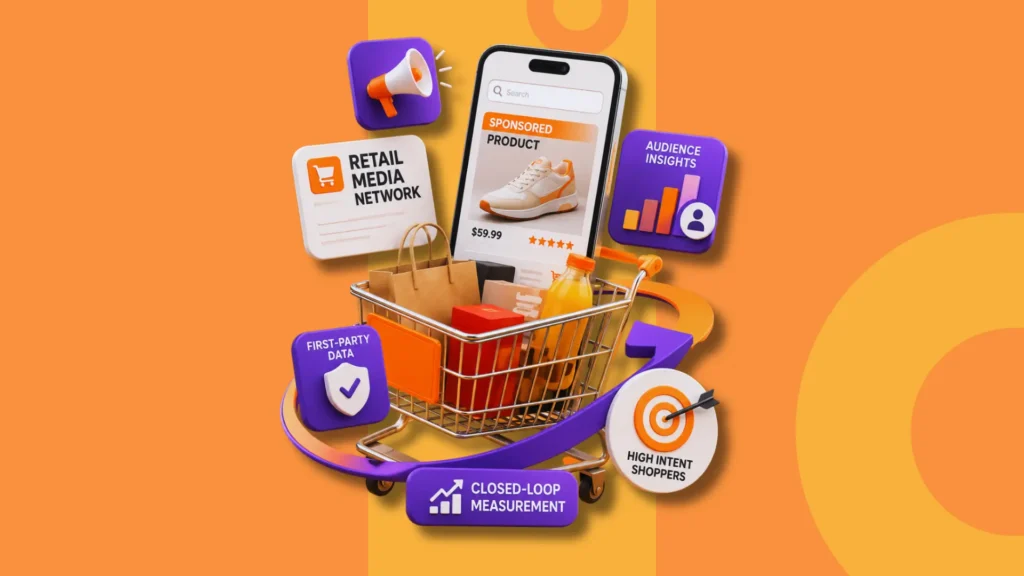
A retail media network is an advertising platform operated by a retailer. It allows brands to buy advertising using the retailer’s customer and transaction data for targeting and measurement.
Think of retail media as the advertising opportunity, while the retail media network is the technology and infrastructure that makes it possible.
Retailers with loyalty programmes, ecommerce sites, and shopping apps are especially well positioned to build RMNs because they have rich customer data. That data helps brands reach shoppers based on actual purchasing behaviour rather than assumptions. As of late 2025, there are 277 retail media networks operating globally.
For advertisers, RMNs offer something increasingly difficult to find elsewhere: the ability to reach high-intent shoppers at the moment they’re making purchase decisions, all within a first-party environment.
How does retail media networks benefit advertisers?
A retail media network gives advertisers access to something increasingly difficult to find elsewhere: real purchase data and high-intent audiences.
Purchase-intent targeting at the point of decision
Retail media ads appear while shoppers are actively searching, browsing, or buying products. Unlike social or display advertising, where intent is often inferred from behaviour, retail media can reach consumers at the exact moment they are considering a purchase.
First-party data access without third-party tracking
Retail media also provides access to first-party data without relying on third-party cookies. Retailers can use loyalty programmes, registered accounts, and transaction histories to help brands reach shoppers based on actual buying behaviour. This has become increasingly valuable as privacy regulations and browser changes limit traditional tracking methods.
Competitive shelf-space defence and category visibility
Another benefit is visibility within the retailer’s digital shelf. Sponsored products help brands appear prominently in search results and category pages. Without retail media investment, even well-known brands can lose visibility to competitors that are actively bidding for premium placements. As a result, retail media often serves both offensive and defensive marketing objectives.
Non-endemic and full-funnel brand-building
Retail media is also expanding beyond traditional retail advertisers. Financial services, travel companies, automotive brands, and insurers increasingly use retailer audience data through off-site channels such as programmatic display and CTV. This allows them to reach highly relevant audiences even if they do not sell products through the retailer itself.
As retail media networks continue to mature, they are evolving from lower-funnel performance tools into full-funnel advertising platforms capable of supporting both brand awareness and sales growth.
What is the difference between on-site and off-site retail media?
| Feature | On-Site Retail Media | Off-Site Retail Media |
| Where ads appear | Retailer’s own website, app, email, and digital properties | External channels such as the open web, social media, CTV, and digital audio |
| Data used | Retailer’s first-party shopper data | Retailer’s first-party shopper data |
| Common formats | Sponsored products, search ads, display banners, CRM/email placements | Display, video, CTV, social, and programmatic advertising |
| Shopper intent | High, because shoppers are already browsing or buying products | Varies by channel and campaign objective |
| Buying environment | Retailer’s owned inventory | Third-party inventory |
| Scale | Limited by the retailer’s traffic | Can reach audiences across a much larger digital ecosystem |
| Primary use case | Drive conversions close to the point of purchase | Build awareness, retarget audiences, and support full-funnel campaigns |
| Technology | Retail media platforms and retailer-owned ad inventory | DSP integrations, data clean rooms, and audience activation tools |
In-store retail media
This is often treated as a third category. It includes digital screens, audio announcements, interactive kiosks, and electronic shelf labels inside physical stores. As retailers connect these formats to loyalty data, brands can increasingly measure how in-store media influences purchases through closed-loop attribution.
What is sponsored product advertising and how is it different from programmatic display?
Sponsored product advertising is a native ad format that places a brand’s products in prominent positions within a retailer’s search results or category pages. These ads look similar to regular product listings but receive greater visibility through an auction process. Advertisers typically pay on a CPC (cost-per-click) basis and only incur a cost when a shopper clicks the product listing.
Programmatic display, by contrast, is not an ad format but a buying method. It uses DSPs, SSPs, ad exchanges, and RTB (real-time bidding) technology to automate the purchase of display, native, video, and rich media advertising. Programmatic display can run both on a retailer’s properties and across external websites, apps, and CTV platforms.
| Feature | Sponsored Product Advertising | Programmatic Display |
| Nature | Ad format | Buying method |
| Pricing model | CPC (cost-per-click) | Usually CPM (cost per thousand impressions) |
| Placement | Retailer’s search results and category pages | On-site or off-site inventory available through DSPs |
| Buying platform | Retailer’s self-serve platform | DSP such as The Trade Desk, DV360, or StackAdapt |
| Targeting | Keywords and shopper audiences | Audience segments, contextual, geographic, and behavioural targeting |
| Relevance signal | Product relevance to a shopper’s search query | Audience match to campaign targeting criteria |
| Shopper intent | Typically high, as shoppers are actively searching for products | Varies depending on channel and campaign objective |
| Ad appearance | Native product listing | Banner, native, video, or rich media formats |
A sponsored product ad is always on-site and designed to influence shoppers close to the point of purchase. Programmatic display can be on-site or off-site and is used across different stages of the customer journey. Many retail media campaigns use both together: sponsored products to capture active shoppers and programmatic display to build awareness, retarget audiences, and drive conversions using the retailer’s first-party data.
How is retail media measured and attributed?
Retail media measurement typically involves three approaches.
Attribution
This assigns credit for a sale to advertising touchpoints that occurred before the purchase. Common models include last-touch attribution, multi-touch attribution, and view-through attribution.
Incrementality Testing
This measures whether advertising actually caused additional sales. Advertisers compare a group exposed to ads with a control group that did not see them and measure the difference in results.
Marketing Mix Modelling (MMM)
MMM uses historical data such as ad spend, sales performance, seasonality, and economic conditions to estimate the contribution of each marketing channel.
Each method answers a different question. Attribution helps optimise campaigns. Incrementality measures true business impact. MMM provides a broader view of channel performance across the entire marketing mix.
What is closed-loop measurement in retail media?
Closed-loop measurement is one of the defining features of retail media. It links an ad impression directly to a verified purchase transaction within the retailer’s ecosystem.
To make this work, retailers connect three types of data. First, media delivery data, showing who saw the ad. Second, identity data, usually tied to a loyalty card, registered account, or app login. Third, transaction data, showing whether a purchase happened afterward.
When these datasets are connected, advertisers can directly observe the relationship between ad exposure and sales. This is what makes the measurement “closed-loop.”
Unlike many traditional advertising channels, the retailer can observe both the advertising event and the purchase event within the same first-party environment. The result is stronger attribution and more reliable ROAS measurement.
However, advertisers should still validate results through incrementality testing, since attributed sales and truly incremental sales are not always the same thing.
What are the examples of retail media networks?
Retail media networks now exist across nearly every major commerce market, spanning grocery, marketplaces, fashion, health and beauty, and quick commerce.
In the United States, leading examples include Amazon Advertising, Walmart Connect, Kroger Precision Marketing, Target Roundel, and Instacart Ads.
In the United Kingdom, major networks include Tesco Media and Insight Platform, Nectar360, Boots Media Group, Asda Media Partnerships, Ocado Media, and Co-op Compass.
India’s growing retail media market is led by Flipkart Ads, Amazon India Ads, Myntra Advertising, BigBasket Ad Platform, and emerging quick-commerce players such as Blinkit and Zepto.
In Australia, Coles Group Ads and Woolworths Everyday Rewards Media dominate the grocery retail media landscape.
Across Europe, notable networks include Zalando Marketing Services, Carrefour Links, and REWE Digital Ads. In China, retail media is largely driven by Alibaba, JD.com, and Pinduoduo, where advertising and commerce are deeply integrated.
FAQs
Is retail media only for FMCG brands?
No. Any brand can use retail media if its target audience shops with a retailer. Even non-endemic advertisers such as banks, travel companies, and automotive brands increasingly use retailer audience data through off-site activations.
What is the difference between a retail media network and a walled garden?
A walled garden (Google, Meta, Amazon) controls both the audience and the inventory within a closed ecosystem. Retail media networks can be more open and may allow audience activation through DSPs, clean rooms, and external partnerships.
Can media buyers access retail media through their existing DSP seat?
For off-site retail media, often yes. If the retailer has DSP integrations, advertisers can activate retailer audiences through existing buying platforms. On-site campaigns usually require access to the retailer’s own platform.
What is a clean room in the context of retail media?
A clean room is a privacy-safe environment where retailers and brands can analyse overlapping datasets without sharing raw user-level data. It supports audience matching, measurement, and attribution while maintaining privacy controls.
What does “endemic” versus “non-endemic” mean in retail media?
Endemic advertisers sell products on the retailer’s platform. Non-endemic advertisers do not sell through the retailer but want access to its audience data.
Final Takeaway
Retail media has evolved from a niche trade marketing tactic into a major digital advertising channel.
Its biggest advantage is simple: access to first-party transaction data that shows what people actually buy.
For advertisers, understanding the differences between on-site retail media, off-site retail media, sponsored products, and programmatic display is becoming increasingly important.
On-site formats help capture shoppers when purchase intent is highest. Off-site retail media extends retailer audiences across the broader digital ecosystem. Closed-loop measurement helps connect media spend directly to sales outcomes.
Retail media is not replacing programmatic advertising. Instead, it adds a layer of purchase-based targeting and measurable attribution that many brands have been searching for in a privacy-first world.
As retail media networks continue to mature, they are evolving from lower-funnel performance tools into full-funnel advertising platforms capable of supporting both brand awareness and sales growth. For media buyers managing campaigns across multiple retail media networks, platforms like Vizibl help consolidate audience activation, creative delivery, and reporting across both on-site and off-site retail media inventory from a single interface.