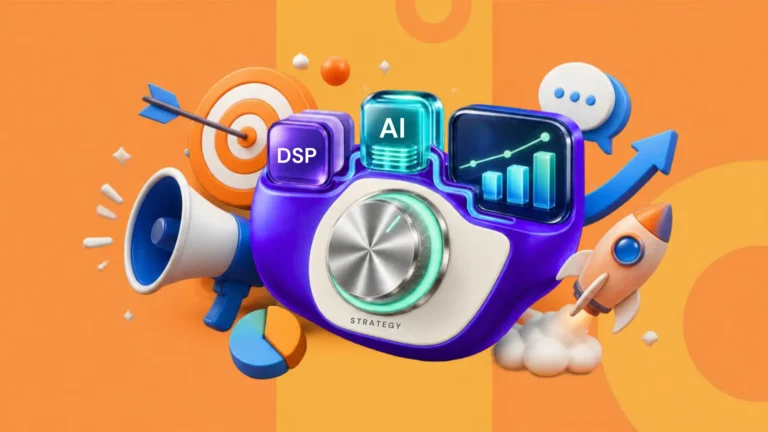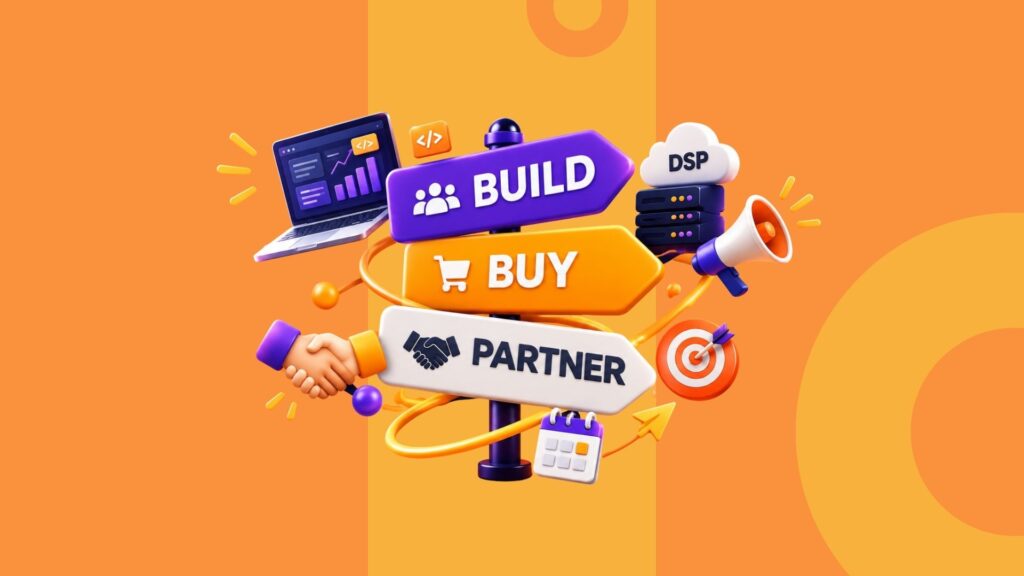
A client asks for something your DSP can’t do. Maybe it is CTV inventory, a retail media integration, or a second platform to test against. Suddenly, you have to choose: build the capability in-house, buy direct access to an enterprise DSP, or partner with someone who already has it.
For many agencies, the choice isn’t really a choice. There’s a gap to fill, a client to keep happy, and a platform decision that needs to be made quickly. So the immediate fix becomes the long-term setup, until the platform changes its terms, gets acquired, or leaves the market altogether. MediaMath filed for Chapter 11 in 2023, while Microsoft announced that it would stop supporting media buying through Microsoft Invest from February 28, 2026. Both are reminders that the easiest platform to choose today isn’t necessarily the one you want to be dependent on tomorrow.
We work with agencies on this exact problem. Here is what each route costs, who it suits, and how to pick on purpose.
TL;DR
- Build gives you full control, but requires ongoing investment in engineering, ad ops and programmatic expertise.
- Buy (going direct to a DSP) is quick to start, but access can come with platform-specific spend requirements and commercial terms that may not suit smaller agencies.
- Partner means you don’t hold the DSP contract, but you can get multi-DSP access without building and maintaining the capability in-house.
- Rule of thumb: build if you have steady programmatic volume across a wide roster. Buy if one platform covers most of your clients and its requirements work for you. Partner if you need broader access without taking on the full cost and responsibility of building it yourself
Build, buy and partner; compared
Here’s the table restructured with a label column on the left, so each attribute is named once instead of repeated in every cell:
| Build | Buy direct | Partner | |
|---|---|---|---|
| Upfront cost | High: people, technology and operational setup | Low to medium, depending on platform and commercial terms | Low to medium, depending on the partner model |
| Ongoing headcount | Permanent trading, ad ops and potentially technical support | Trading and ad ops team | Lower internal operational requirement |
| Control | Full | High: you hold the direct relationship | Shared: depends on the agreement |
| DSP flexibility | High, once multiple capabilities are established | Depends on your direct DSP relationships | High if the partner provides access to multiple DSP environments |
Your screenshot cuts off after DSP flexibility, so if there are more rows below it, send me the rest and I’ll add them. If you need this as HTML or CSS for a webpage, I can give you that instead.
What does building in-house cost an independent agency?
Building means creating the programmatic capability in-house: your own trading function, direct platform relationships, ad operations and the processes and technology needed to run campaigns.
The launch is the smaller part of it. Someone has to keep platform relationships and integrations working, stay current with each DSP’s requirements, and run campaigns across different environments. Each time a platform changes its API, targeting options, measurement capabilities or identity approach, your team has to adapt.
The cost is therefore not just the initial setup. It is the ongoing investment in people, training, technology and operational support.
Timing is another consideration. Without a programmatic team already in place, building a new capability takes time. Your client may want the new channel now, while your agency is still hiring and setting up processes.
Build makes sense when you have steady volume across enough clients to justify permanent capability. One large client asking for one new capability isn’t necessarily enough of a reason to build.
What does buying direct cost an independent agency?
Going direct to a DSP such as Display & Video 360 or Amazon DSP gives your agency a direct platform relationship and greater control over the commercial and operational setup.
Some clients may prefer that structure for transparency or procurement reasons.
The catch is in the terms. Direct access does not follow one universal commercial model. Requirements vary by platform, market and access route.
Amazon, for example, currently offers both self-service and managed-service options for Amazon DSP. Its managed-service option typically requires a minimum spend of $50,000 in the US, although the minimum can vary by country. Self-service customers manage their own campaigns and do not pay management fees.
Display & Video 360 also operates through partner and advertiser structures, with platform fees and payment terms determined by contract. Google states that Display & Video 360 partners represent agencies, trading desks or large individual advertisers, and that partner-level requirements include business, team, expertise and client-engagement criteria.
So the question for an independent agency is not simply whether it can access a DSP. It is whether the access model and commercial terms make sense for the volume and client mix it has.
If your spend is spread across several platforms, committing to one direct relationship may also create pressure to consolidate more activity onto that platform than you otherwise would.
Buying direct works best when one platform covers a significant share of your clients and you can meet its current access and commercial requirements without distorting your media plans.
What does partnering cost an independent agency?
Partnering gives you access to additional DSP environments and programmatic expertise without requiring you to build every capability or establish every direct platform relationship yourself.
The cost is control: you rely on someone else’s infrastructure, platform relationships and operational support. If you need to say, “we hold the contract directly” for regulated, government or large enterprise clients, that can be a real downside.
For many independents, the trade-off can be worthwhile. You can focus internal resources on client strategy and campaign outcomes instead of building and maintaining an entire programmatic function.
Partnering carries risk, so ask four questions before you sign:
- Who holds the seat? Is it yours or theirs?
- Do you get log-level data? Or only summary reporting?
- How are fees and margin structured? Can you see exactly what you pay?
- Can you leave? Can you take your campaigns, audiences and data with you?
A partner who can’t answer all four plainly isn’t the right one.
How should you decide?
Four questions settle most cases:
- How varied is your roster? If most clients have similar targeting and inventory needs, one platform may be enough. If not, you may need access to multiple DSP environments.
- What is your quarterly programmatic spend, and how does it compare to the requirements you’d face? Look at your actual and expected volume rather than assuming that every DSP has the same minimum. Commercial terms vary by platform and access model, so check the current requirements before committing.
- Do you want to own and maintain infrastructure for years? Build only makes sense if you have sustained demand and are willing to carry the permanent operational and technical responsibility that comes with it.
- How much do your clients care who holds the contract? In regulated sectors, procurement or governance requirements can make direct platform relationships more important. For many clients, speed, campaign quality, transparency and results may matter more..
And don’t confuse access with strategy. Platform access doesn’t make a campaign good. Pick the route that fits your business, then put your effort into audience, objectives and measurement. We’ve written more on that in our post on AI in media buying.
FAQs
How much does it cost to build an in-house programmatic team?
There is no single reliable industry-wide figure. The cost depends on the size of the team, number of platforms, markets, campaign volume, technology requirements and level of internal automation. The investment can include trading and ad operations salaries, platform training, technology, reporting, integrations and ongoing maintenance. It pays off when the agency has enough sustained programmatic demand to justify maintaining that capability.
What are DSP minimum spend requirements?
DSP requirements vary by platform, market and access model. Some managed-service arrangements have minimum spending commitments, while self-service options may have different or no management-fee structures.
For example, Amazon currently states that its managed-service option typically requires a minimum spend of $50,000 in the US, with the minimum varying by country. Its self-service option allows advertisers to manage campaigns themselves without a management fee.
Agencies should confirm current requirements directly with each DSP before making a decision.
What is a managed-service DSP partner?
A managed-service partner already holds relationships and infrastructure across several DSPs and runs or supports your campaigns through them. You get access and ad ops support without building or contracting for it yourself.
Do I need my own DSP seat?
Not always. You need one if your clients require you to hold the contract directly, or if you spend enough on one platform to make it worthwhile. Otherwise a partner’s seat can give you the same access faster, as long as you have clear data and exit terms.
Does partnering mean losing control of client campaigns?
No. You keep strategy, creative and client relationships. What changes is who holds the direct relationship with the DSPs.
Can I combine approaches?
Yes, and many agencies do. A common setup is building limited in-house capability around one core platform for steady, high-volume work, and partnering for multi-DSP access on newer or smaller accounts.
The bottom line
All three routes solve the same problem, access to programmatic, at different costs and speeds. The mistake is letting a deadline choose for you. Decide before a client forces the question, and you won’t be scrambling the next time a platform changes its terms or leaves the market.